
Weather Warfare Systems Destroyed by Iran

“Today our country is moving towards drought, which is partly unintentional due to industry and partly intentional, as a result of the enemy destroying the clouds moving towards our country and this is a war that Iran is going to overcome.”
Iranian President Mahmoud Ahmadinejad in a speech given on September 10, 2012.
That same year, 2012, Vice President Hassan Mousavi urged meteorologists to begin seeking the causes of the drought. Their investigation led many government officials and military leaders to believe that weather modification might be a contributing factor to the year-by-year decrease of rain and snow. One military leader, National Security Council chief Saeed Jalili in 2018, specifically accused Israel for creating drought conditions in Iran and “stealing its snow.”
Rainy season in the Middle East begins in October and ends in May. Storms come from the Caspian Sea, the Black Sea, and the Indian Ocean, but mainly they come from the western part of the Mediterranean Sea. Traveling eastward, they sweep over Greece and Cyprus and reach the coastlines of Israel, Lebanon, and Syria in about two to four days. After Jordan and Iraq, they eventually reach Iran. Usually, precipitation occurs during the cooler months and leave a heavy snowpack in the mountains of Alborz and Zagros. During the hot, dry summers, melting snow sends water down to the central plateau where numerous cities are located.
Starting in 2021, a dramatic shift in weather patterns occurred on the Mediterranean Sea. Until recently, if a storm stalled in its forward motion of travel, it would churn up cold water from deep beneath the surface and quickly kill its own energy supply. However, a recently recognized phenomenon called “marine heatwaves” are generating deep thermal reservoirs, which allow storms to sit for days on the same patch of water without cooling down. In 2021, a stalled cyclone named Apollo triggered multiple, devastating waves of flash flooding in Sicily. Storm Daniel took a stationary position off the coast of Greece in September 2023 for six days, dropping a years-worth of rain (750 mm or 29 inches) and submerging the agricultural plain of Thessaly. It finally turned south toward Libya where it dumped 400 mm of rain (16 inches) in 24 hours, causing catastrophic dam collapses. Devastating storm systems also occurred in 2022 and 2024. Storm Byron battered Greece and Cyprus in December 2025 with some 100 to 200 millimeters (4 to 8 inches) of rain, strong winds, and severe flooding. It then moved on to strike Israel and the Gaza Strip simultaneously. For Israel, the storm was a difficult challenge, inconvenient, disruptive, but ultimately manageable by emergency services and working drainage systems. But under the same sky, in the blockaded Gaza Strip, the storm caused prolonged devastation. A total of 150 mm, nearly half the region’s annual rainfall, occurred over several days. Torrid downpours swept away makeshift tents of thousands of displaced Palestinians. Sewage and drainage systems failed to work, having been damaged by months of bombardment. Flooding ruined food and clean water supplies and caused buildings to collapse.
Slow-moving or non-moving storms on the Mediterranean Sea continually drain cloud formations of water before they make landfall in the Middle East. Lack of rain reduced the Tigris and Euphrates Rivers to an all-time historic low of 27% below normal levels. About 98% of Iraq’s water needs comes from these two rivers. In Syria, a lack of rain led to a collapse in agriculture, particularly affecting wheat and barley production in Aleppo and Idlib. Widespread, exceptional water deficits also plagued Lebanon and Jordan. Israel on the other hand managed to overcome the dry years through conservation and its five desalination plants, which supply about 80% of its drinking water.
Water scarcity in Iran was particularly dire. Over twenty provinces, including Tehran, Isfahan, and Khuzestan, encompassing three-quarters of the country, received almost no measurable rain for extended periods. The autumn of 2025 was the worst in fifty years, with an 89% decrease in rainfall compared to historical averages. Dozens of major dams dropped below 5% of their total capacity. In November 2025, Tehran’s five reservoirs collectively held barely 250 million cubic meters of water, representing an average of about 10% of their total storage capacity. According to the World Resources Institute, Iran was facing “water bankruptcy” due to five consecutive years of drought and unsustainable water use. Stringent water-saving measures became necessary including public holiday closures, rationing, and rolling water cuts in major cities
The capital city of Tehran with a population of ten million inhabitants sits at the southern foot of the Alborz mountains and the northern edge of the central plateau. Historically, its total rainfall per year is 350 mm. Above normal rainfall occurred during the 2019 season, but since then, rainfall totals steadily declined.
2020: 291.5 mm
2021: 134.8 mm
2022: 129.8 mm
2023: 165.6 mm
2024: 152.1 mm
On the other side of the Gulf, rainfall averages for Kuwait, United Arab Emirates, Bahrain, Qatar, Oman, and Saudi Arabia are historically lower than Iran’s due to a hot, desert climate. Given this situation, it might be expected that during the drought years, they would have scarcely any rain or perhaps none at all. Interestingly, this is not the case. The city of Dubai in the UAE, about 240 kilometers (150 miles) from the coast of Iran, has a baseline annual rainfall average of 77 mm. Any water depletion that occurred in 2021 was more than resupplied by the three years following.
2020: 106.0 mm
2021: 31.0 mm
2022: 72.0 mm
2023: 149.2 mm
2024: 250.0 mm
Manama, Bahrain, which has a baseline average of 72 mm also had several good years of rain.
2020: 73.0 mm
2021: 83.0 mm
2022: 59.8 mm
2023: 95.8 mm
2024: 81.8 mm
Higher than average rainfall could be attributed to the UAE’s aggressive use of cloud-seeding technology. Its first attempts occurred in 1982 and continued on through the 1990s. In the late 1990s it developed a comprehensive program in cooperation with NASA and U.S. National Center for Atmospheric Research. In the early 2000s it received investments of millions of dollars to formalize flight operations and scientific research. According to several newspapers and magazines, the UAE had succeeded in creating over fifty artificial rainstorms between July and August 2010 near Al Ain, a city near the border of Oman. Specialized planes currently conduct hundreds of missions every year. In 2021, the UAE started using “cloud-busting drones.” Flying into clouds and zapping them with a positive or negative charge, these drones can alter the electrical balance of a cloud. The cloud disappears as tiny suspended droplets merge into heavier drops and fall to the ground as a rain shower.
Although rain water is a significant factor in meeting the needs of the countries on the west side of the Gulf, it is not the most important one. Eighty to ninety percent of potable water comes from desalinization plants. Their proximity to the Gulf makes desalinization a practical way of generating abundant amounts of freshwater. What’s more, these countries are continually upgrading or expanding their plants or building new ones.
Iran on the other hand is heavily dependent on rain-fed rivers and reservoirs. In the northwestern part of the country, thirteen rivers flow into Lake Urmia, one of the largest saltwater lakes in the world. It once had a surface area of 6000 square kilometers. Not too long ago, it was a tourist attraction with hotels, beachside restaurants, and boat tour companies. Nearby farms relied on river water to irrigate crops, such as apples, sugar beets, tomatoes, wheat, alfalfa, and barley. Beginning in the late 1990s the lake began to dry up at an alarming rate. Poor water management as well as drought led to receding shorelines. Aquifer depletion caused soil acidification and increased salinity. Faced with skyrocketing irrigation costs and declining crop yields, many people had no choice but to abandon their farms. In 2008 the tourist infrastructure of the once bustling port of Sharafkhaneh began to collapse, forcing the closure of dozens of guest houses. Businesses that once thrived along the shoreline became a gloomy assemblage of shuttered, derelict, and abandoned buildings. Satellite imagery from NASA and the European Space Agency showed that by 2025 the lake shrunk to a record low of 581 square kilometers, a tenth of its former size.
From September 2025 to February 2026, rainfall in the city of Tehran plummeted to a shocking low of only 1 mm, a drop of 95% compared to its historical seasonal average. Faced with a climate catastrophe with no end in sight, President Masoud Pezeshkian said on November 20 that the time was at hand when the abandonment of the city must be given serious consideration. “The reality is that,” said the president, “we have no choice but to relocate the capital. It is a necessity.”
To stave off a logistical nightmare, the Iranian government took a cue from the UAE and began its own cloud-seeding efforts on November 15, 2025. Using aircraft loaded with silver or potassium iodide particles, they hoped that by spraying these chemicals into cloud formations, they could induce rainfall. At first it seemed promising. Some regions received above average rainfall particularly on January 8 and 9 and a second time on February 6 through 8. Yet the cloud seeding was not enough to lift total precipitation above long-term averages and replenish depleted reservoirs.
At shrines and mosques across the country thousands of Iranians gathered together and prayed fervently that God would bring back the rain. God heard their prayers, and a miracle occurred.
On February 28, the US and Israel opened hostilities against Iran with 900 airstrikes, including a so-called “decapitation strike” to eliminate the head of state, the Ayatollah Ali Khamenei. Another controversial airstrike was the destruction of a girl’s’ school in Minab by Tomahawk cruise missiles. Over a hundred children and dozens of teachers and parents were killed.
In retaliation, Iran struck at least sixteen military bases belonging to the US in eight countries (six in Kuwait, three in Bahrain, one in Qatar, two in UAE, one in Jordan, one in Saudi Arabia, one in Cyprus, and one in Iraq). Trump administration officials and the Pentagon refused to disclose the extent and nature of the damage due to concerns about “operational security,” but aerial images coming from Iranian and Chinese satellites showed extensive damage with several bases rendered “operationally unusable.” Aircraft shelters, planes on the ground, fuel depots, barracks, gymnasiums, warehouses, and runways were heavily damaged by drones and missiles. Especially hard-hit were critical radar installations, which served as the backbone of regional air defenses. They detected approaching threats at long distances, computed their speed and trajectory, and fed real-time data to crews attempting interception with aircraft and missiles.
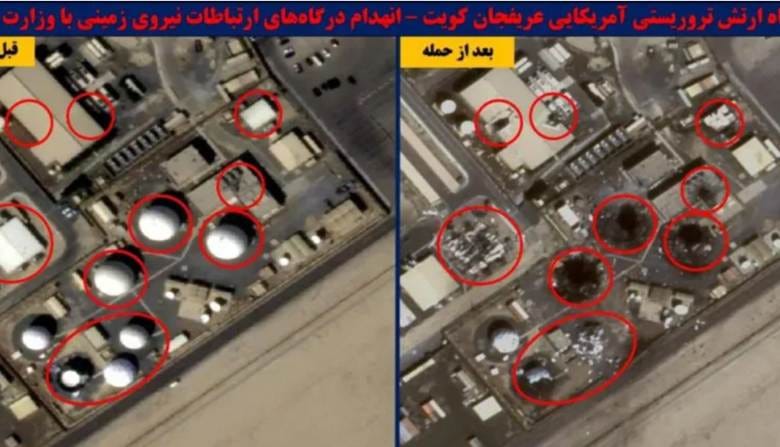
Images circulated by Iranian channels show clustered missile impact points precisely aligned with radome locations inside Camp Arifjan in Kuwait
The golf ball structures are called radomes at Camp Arifijan, Kuwait. They house satellite dishes vital for data transmission. As shown below, Iran destroyed all but one.
The loss of radars for defense also meant the loss of the ability to monitor and track the weather. Military radars can perform both functions equally well. By transmitting short bursts of microwave energy and listening for the returning echoes that bounce off precipitation particles like rain, snow, or hail, radars can track the speed, path, and intensity of approaching or departing storm systems.
Also destroyed by the Iranians were the highly sophisticated NEXRAD towers, or Next Generation Weather Radar. Unlike conventional radars that transmit only horizontal beams, NEXRAD can do both horizontals and verticals. By comparing the two, meteorologists can distinguish heavy rain, hail, or even airborne tornado debris.
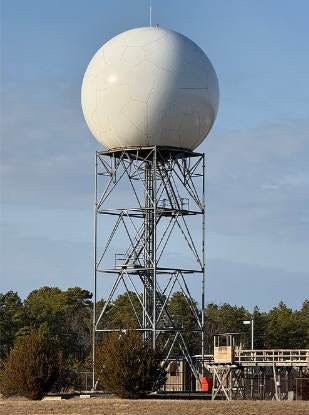
NEXRAD tower at Fort Dix New Jersey
According to Dane Wigington, founder of the website Geoengineering Watch, NEXRAD can also be used to modify the weather. Working in tandem with aircraft seeding the atmosphere with electrically conductive nanoparticles, such as aluminum and barium, NEXRAD operators can push, repel, or guide storm clouds in whatever direction they choose. They can also keep rain from coming down by directing microwave beams into clouds and turn suspended water drops back into vapor.
The obliteration of the radar infrastructure in the Gulf region was soon followed by the first appearance of substantial amounts of rain. On March 7 burning oil depots created an unconventional weather phenomenon called “black rain.” Massive plumes of smoke rose up into the sky to mix with atmospheric clouds. The rain that fell contained heavy soot and toxic chemicals, which triggered a variety of health problems including acute respiratory issues and skin irritation. Around March 23, a powerful persistent weather system brought intense rainfall to western and southern Iran. It was the same mega storm that swept over other countries of the Middle East including Jordan, Syria, and Iraq. On April 12, an unexpected heavy downpour rapidly eroded the iron-rich soil of Hormuz Island, which changed the surrounding coastal waters into a dramatic crimson color. But these are minor events compared to what occurred in the latter half of April and the first ten days of May.
On April 18, people in Tehran were surprised to see rain coming down – not just a scattering of drops but a torrential downpour. Joyous people stood out in the rain holding their hands up high in gratitude to a merciful God. For three days so much rain came down, that it was flooding the streets. The flood of waters brought a revival of Lake Urmia. Heavy inflows helped increase the lake’s surface area from a shrunken size of 581 square kilometers to an astonishing 2,350 square kilometers in just a few weeks. As of late April, Iranian authorities had to issue “orange alerts” for an additional fourteen provinces, due to anticipated heavy rains, thunderstorms, and strong winds. Temperatures dropped below freezing, and on April 21, a record-setting snow storm swept over several provinces. This huge amount of precipitation brought significant water runoff and helped replenish depleted dam reservoirs.
The rain storm of April 18 through April 21 originated as a low-pressure zone over the Mediterranean Sea. Driven eastward by a volatile jet stream and an active El Niño cycle, it drew immense, supercharged moisture from the Red Sea and the Persian Gulf. This created an atmospheric river that funneled massive amounts of precipitation directly into Iran. A dense, moisture-laden air mass collided with the Alborz mountain range, triggering localized cooling, heavy downpours, and unseasonal snowfall.
Although heavy rainfall increased the capacity of dams to full or overflowing in the coastal, western, and northern provinces, reservoir recovery was not uniform nationwide. By the end of the rainy season, the five dams supplying water to the city of Tehran still remained critically low at 18%. Despite drenching downpours, the cumulative rainfall total for the capital city was 166.2 mm, much less than its long-term historical average of 350 mm. Strict water rationing was still necessary ahead of the peak summer heat. Nevertheless, 18% is an improvement over the 10% that existed three months earlier.
The onset of abundant amounts of rain not only affected Iran but also other countries in the Middle East. The months of March and April brought to Israel, Syria, Jordan, and Iraq exceptionally heavy, disruptive rainfall and widespread flooding, primarily driven by a powerful weather system.
Many Iranians believed the return of the rains was proof of divine intervention. Others saw an additional factor to explain the sudden onset of long-delayed rainfall.
ViralMind posted the following on X (formerly Twitter):
MIND-BLOWING!
After Iran took out that secret cloud-seeding & weather-modification center in the UAE…
Everything flipped overnight.
Iraq and Iran suddenly get heavy rain every single week. Temperatures dropped a full 5°C — a massive shift.
Iran’s devastating drought is over. Floods have returned so strongly that the government [no longer needed] to move the capital from Tehran because of water shortage.
That center wasn’t just research — it was designed to destroy agriculture and livestock in Iran and Iraq by triggering artificial drought and desertification.
Anyone who doesn’t believe it, go search “Project HARP” and see how one project can completely change weather patterns.
Daily News Iran had a similar post:
Weather is completely changed in Iran now. Massive rains, snow, and temperatures have dropped significantly. Why? Because there’s no more weather engineering after American radars were destroyed in the region.
Pro-Iranian websites suggested that the destruction of at least three THAAD (Terminal High Altitude Air Defense) batteries and their early warning radars (AN/FPS-132) disrupted a regional “weather manipulation network.”
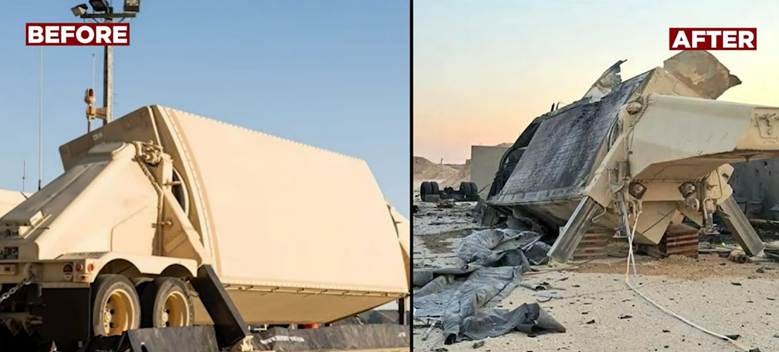
THAAD missile battery wrecked
Ben Swann, a highly regarded independent journalist, had a news segment regarding weather weapons and their use against Iran.
Videos have poured into the newsroom showing heavy rainfall over areas across Iran. And this has been going on now for weeks. In some places, water is rushing through the streets. In other regions, they are experiencing not only massive rainfall, but even snowfall. These are places that for over a decade were dealing with a severe drought. In fact, that drought was so severe for the last few years that it was thought that it could cause the Iranian regime to collapse. The situation was desperate. But now, parts of Iran are seeing more rain than they have seen in over sixty years.
So, what changed? Honestly, a war with the United States, a war in which Iran targeted and destroyed radar systems across the region, including systems that are now believed to be connected to weather modification operations.
Maybe it’s all just a coincidence, right? Maybe. Maybe so. But take a look at this. Turns out the United States has a long history of considering using weather as a weapon against geopolitical opponents. This goes all the way back to 1965. The CIA conducted cloud seeding operations to extend the monsoon season in Vietnam, Cambodia, and Laos. The operation disrupted agriculture and destroyed Northern Vietnamese supply lines during the Vietnam War. As President Lyndon Johnson once said, he who controls the weather controls the world.
Johnson was vice president, not president, when he made his remark about weather control in 1962. Five years later, as president, he authorized secret cloud-seeding programs in Southeast Asia to muddy the Ho Chi Minh Trail and slow down enemy movements.
In the early 1970s, newspaper columnists such as Jack Anderson, James Ridgeway, and Seymour Hersh exposed the secret use of weather modification during the Vietnam War. On May 18, 1977, thirty-one nations, including the United States and the Soviet Union, signed a treaty outlawing the manipulation of the weather for hostile purposes. It is significant, in light of what Saeed Jalili said in 2018, that Israel was not a signatory of the treaty.
If the US is creating drought in Iran in violation of the 1977 treaty, it would have to do so with the cooperation of the mainstream media. Exposes are never written and any allegations that the US is using weather modification technology against other countries are quickly labeled “conspiracy theories.”
A Jerusalem Post article entitled “Stolen rain’ returns? Scientists dismantle viral Iran-Turkey theory” said that any allegations that the US and Israel are using military radar systems to create drought in the Middle East were “neither scientific nor logical.” There is no known method, the Post said, to “steal” or relocate clouds. Current weather modification efforts focus on ways to enhance precipitation in local areas; it cannot control the weather at the regional or intercontinental level.
The Economic Times (of India) had an article entitled “Did Iran just destroy a US-Israel ‘weather weapon’, ending its drought? Viral conspiracy explained.” It said that there is no evidence that missile-defense radars have the additional capability of controlling the weather. According to meteorological experts, sudden weather shifts can occur naturally without the aid of human intervention.
A not easily explainable shift in weather patterns is the recently recognized phenomenon of “marine heatwaves.” It initially appeared in scare quotes in the title of a fisheries research report (The rise and fall of the “marine heat wave” off Western Australia during the summer of 2010/2011 in the Journal of Marine Systems) to describe an unprecedented warming event during the summer of 2011 that led to a rapid dieback of kelp forests along hundreds of kilometers of Australian coastline. Sea surface temperatures peaked at 3°C to 5°C above normal and persisted for several weeks over more than hundreds of miles of coastline.
Since 2021 the Mediterranean Sea has become a global climate hotspot with unprecedented marine heatwaves causing mass mortality of marine life and catastrophic fish die-offs every summer. Historically, the average summer surface temperature in the Mediterranean Sea ranged between 23°C to 26°C (73°F to 79°F). Measurements of global warming on the surface of the Mediterranean Sea show that between 1985 and 1989, the sea warmed at 0.06°C per decade, but between 2019 and 2023, it shot up to 0.27°C per decade. These incremental increases caused by a combination of solar heat and greenhouse gas emissions cannot explain the massive surges in temperatures required for marine heatwaves to exist. In the Mediterranean Sea heatwave temperatures soar past 30°C (86°F). Recent summers have seen waters exceeding 30°C (86°F) as early as late June, weeks ahead of the typical summer peak.
A better explanation of why the Mediterranean Sea, the west coast of Australia, and other places comes from Dane Wigington. He says that marine heatwaves, alongside other extreme weather events such as stalled or slow-moving cyclones, are caused by covert climate engineering and weather modification technologies. These artificially produced heatwaves are responsible for causing Mediterranean storms to drop their rainfall prior to reaching the countries of the Middle East. Since Iran is 900 to 1,200 kilometers (550 to 750 miles) from the Mediterranean Sea, it is more vulnerable to precipitation loss than other countries closer to the sea.
Also driving the drought in Iran are the weather monitoring and weather modification radar installations located on US bases near the Persian Gulf. Contrary to the claim of The Jerusalem Post weather modification can indeed be regional and intercontinental.
In his closing remarks Ben Swann said
So, has a weather war been waged on Iran over the past several decades? A war to create drought conditions, destroy agriculture, potentially bring the nation to its knees? And if it was, Iran may have just broken free in a very unexpected way.